
Reviewed · COMMUNIST HERITAGE TOURS
Sofia Communist History 2-Hour Tour in a Classic Trabant
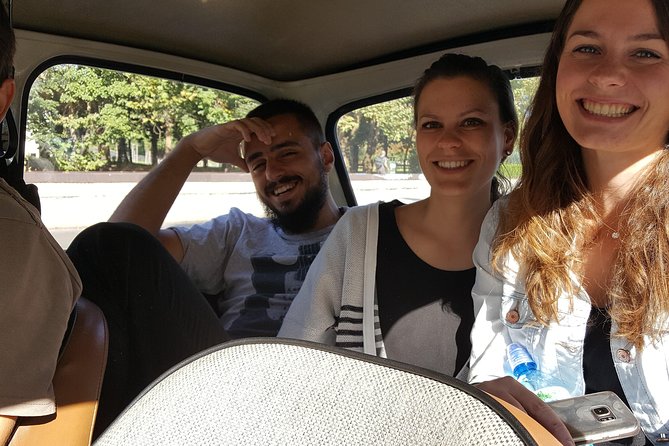
Sofia’s communist past feels more immediate when you see it from the front seat of a classic Trabant, the small East German car once linked with life behind the Iron Curtain. Danny and Rado guide the drive with history, personal family stories, and plenty of time to explain what you are seeing.
I like the private format, which keeps the group to three and lets the guide adapt the conversation to your interests. I also like the practical route: the National Palace of Culture, the former Communist Party center, the National Assembly, and the Museum of Socialist Art give you a useful first look at Sofia’s socialist-era story in a short time.
The main thing to consider is the price: $240.28 per group is fair for three people, but expensive for one or two. The advertised tour lasts about two hours, though one recent outing ran for more than three hours, so do not schedule a tight appointment immediately afterward.
Key points before you book
- The Trabant is the star: You ride through Sofia in an original, carefully maintained car that attracts attention wherever it goes.
- Private groups stay small: One booking covers up to three people, with an English-speaking driver and guide.
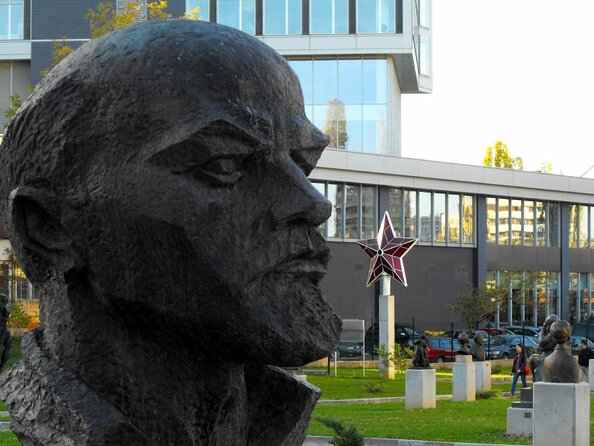
- The Museum of Socialist Art adds depth: You get about 20 minutes inside, plus a look at the sculpture garden and works from the socialist period.
- Hotel pickup is available: Pickup and drop-off are offered at selected hotels, or you can meet at Fridtjof Nansen Street in central Sofia.
- The route works well for a short visit: You cover major communist-era sites without spending a full day in museums.
- History comes through personal stories: Guides such as Danny explain political events alongside family experiences from life before and after 1989.
Why the Trabant changes the Sofia sightseeing experience
A normal city tour can show you Sofia’s buildings. This one gives the city a period setting of its own.
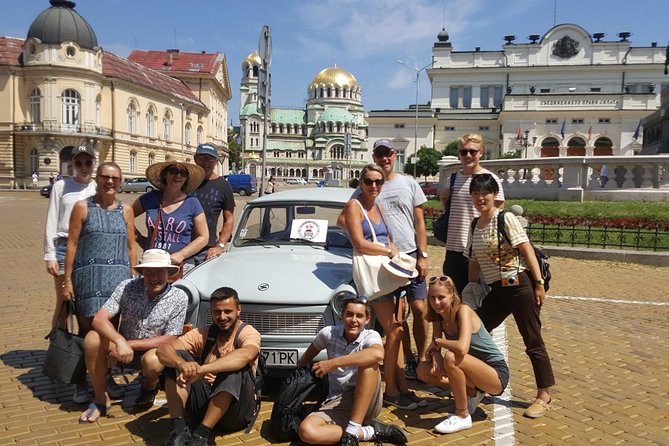
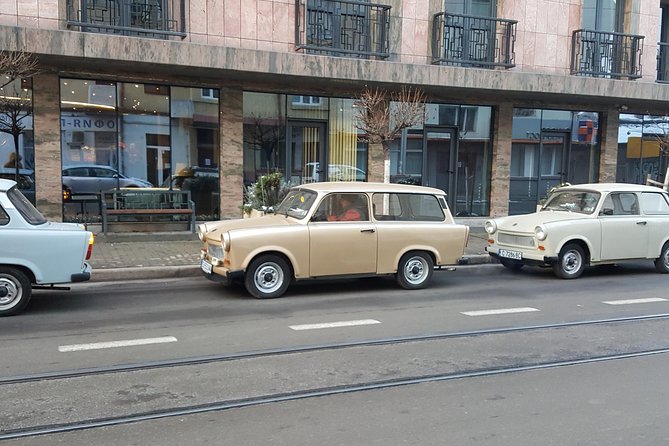
The Trabant was produced in the former German Democratic Republic and became a familiar car across the communist bloc. Its light body, modest size, and unmistakable shape make it more than transport here. The car helps you picture the era in a way that a modern minivan cannot.
You will also draw attention. One account describes people walking past a Ferrari to photograph the Trabant parked outside a hotel. That tells you something about the car’s appeal. It is not luxurious or fast, but it is memorable, unusual, and closely tied to the period being discussed.
I would book this for the story as much as the vehicle. The car creates the mood, while the guide supplies the meaning. Danny is praised for his humor and personal family stories, and Rado is noted for running a particularly strong tour. Since guides may vary, the exact style of the commentary can differ, but the format is built around a friendly, conversational explanation rather than a formal lecture.
The Trabant also makes this a good choice if you want to cover a lot of central Sofia without spending the whole day on foot. You will still get out at the main stops, but the driving links them together quickly.
More communist-era sights in Sofia:
- Communist Walking Tour of Sofia
★ 5.0 · 690 reviews - Sofia Food & Tasting Tour with Communist-Era Tram Ride
★ 5.0 · 35 reviews - Buzludzha Monument and the Museum of Socialist Art
★ 5.0 · 25 reviews
National Palace of Culture and the 1,300-year story
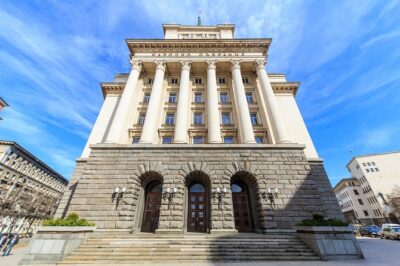
The first major stop is the National Palace of Culture, usually called NDK. You spend about 10 minutes here, discussing the building’s importance and the anniversary of the first Bulgarian state, marked by the number 1,300.
NDK is a useful starting point because it shows how communist governments used monumental public buildings to express national pride and political power. Its scale is hard to miss. The building was created as a major cultural and congress center, and its broad setting gives you a clear sense of the grand style favored by the period.
The stop is short, so expect an introduction rather than a full architectural tour. You will have time to hear why NDK matters and connect it to Bulgaria’s national story, but not time for an extended visit inside.
This is one reason the tour works best as a first orientation to Sofia’s communist-era sites. You get the key idea, see the building in person, and then move on before the pace becomes slow.
Museum of Socialist Art: the most substantial stop
The Museum of Socialist Art is the most focused stop on the route. You spend about 20 minutes inside with the guide, who explains the sculptures and artwork on display. The visit also includes access to the sculpture garden, which adds an outdoor look at the visual language of the era.
This stop matters because communist history is not only about party offices and surveillance. Art was also used to present approved ideas about workers, soldiers, national identity, leaders, and the future. The sculptures can look formal, heroic, or severe, but the guide’s explanation helps place them in their political setting.
Twenty minutes is enough for a useful introduction, especially if you have never seen socialist art in person. It is not enough for a slow museum visit, so art lovers may wish they had more time. Still, the museum gives the tour a stronger cultural side than a drive past government buildings alone.
I especially like this part for visitors who want something they can interpret, not just photograph. The Trabant gets you there, but the museum gives you objects and images to think about. It also helps explain how public art shaped everyday views of authority during the socialist period.
National Assembly, National Archives, and the secret police
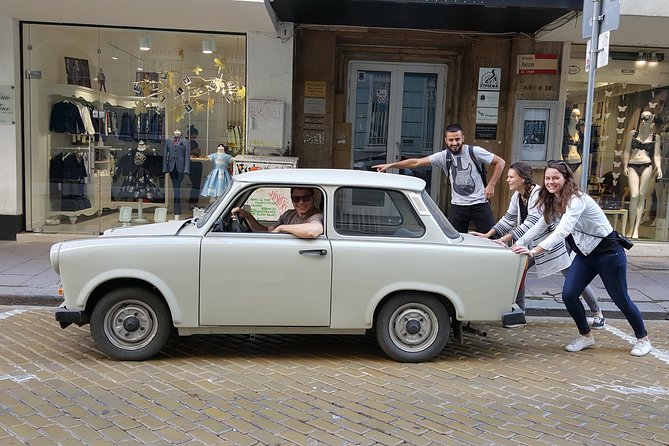
At the National Assembly of the Republic of Bulgaria, the guide walks with you toward the National Archives and explains how the secret police controlled the population. This section lasts about 10 minutes, so the focus is on political power and surveillance rather than a detailed visit to the institutions themselves.
The value here is the connection between imposing state buildings and ordinary life. The communist system was not only visible in monuments and official slogans. It also affected what people could say, what they could publish, where they could travel, and how closely the state watched them.
A short walking segment is useful because it gets you out of the car and lets you see the buildings at street level. You may find this part more direct than the museum stop. It deals with control, fear, and the role of the secret police, topics that can feel abstract until they are tied to actual places in the city.
Do not expect entry into every building. The stated plan describes discussion around the National Assembly and National Archives, with free admission listed for the public sites. The point is the guide’s explanation and the setting, not an extended indoor tour.
More history tours in Sofia:
- Full-day Nis and Serbian History Tour from Sofia
★ 4.5 · 90 reviews - Sofia: History and Heritage – Small Group City Tour
★ 5.0 · 84 reviews - Rila Monastery and St. Ivan Cave History & Nature Trip from Sofia
★ 4.5 · 25 reviews - Bulgarian Food tasting, cullinary-historical tour, Cooking class
★ 4.5 · 15 reviews
The former Communist Party headquarters and 1989
The route also takes in the former Headquarters of the Communist Party and other central Sofia locations connected to the socialist state. The guide explains the political developments that led to the fall of communism in 1989.
This final historical thread is important because it connects the stops. NDK shows the regime’s public ambition. The art museum shows its visual message. The National Assembly and Archives introduce control. The discussion of 1989 explains how that system came apart.
The tour is strongest when you treat these sites as pieces of one story rather than separate photo stops. Your guide can explain how Bulgaria’s political order changed, then add personal or family memories of the years after the fall of the Berlin Wall. Danny, in particular, is described as sharing firsthand family experiences, which gives the subject a human scale.
The itinerary does not give a precise time for this final discussion, so the exact balance between driving and stopping may vary. That flexibility can be useful if you have a particular interest in politics or daily life. It also means you should not expect a rigid minute-by-minute schedule.
What the private three-person format gives you
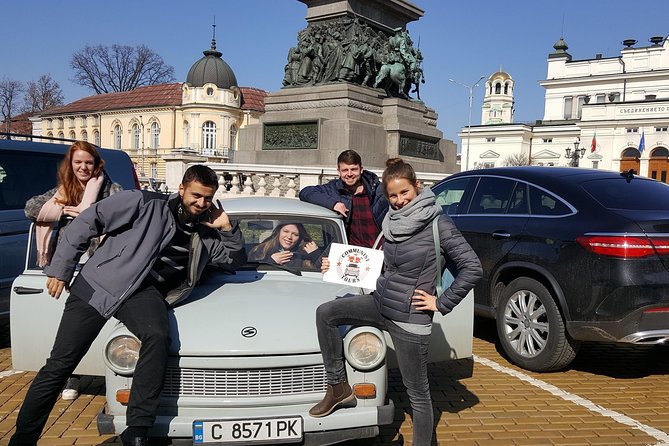
The tour accepts a maximum of three people per booking. That is a real advantage for conversation. You can ask about the Trabant, Bulgarian family life, the secret police, or the 1989 transition without competing with a large group.
The private format also makes it easier for the guide to adapt the tour. One account specifically describes a guide shaping the experience around the group’s interests. If you are more interested in architecture, the political system, art, or personal stories, say so early.
There is a practical tradeoff. A Trabant is a small car, and three passengers may feel snug depending on the vehicle and seating arrangement. The supplied information confirms a maximum of three, but it does not describe the interior dimensions or seating setup. If comfort is a major concern, ask the operator before booking.
The car itself may also have old-fashioned fittings. One person singled out the seatbelt as memorable, which suggests you should expect a genuine vintage vehicle rather than a modern car dressed up for photographs.
Price, timing, and pickup details
The price is $240.28 per group of up to three. For three people, that works out to roughly $80 per person. For two, it is about $120 each, and for one person it is a costly private outing.
I think the value is strongest for a small group that wants a distinctive Sofia activity and private guiding. You are paying for the car, the driver-guide, fuel, hotel pickup and drop-off at selected hotels, and a compact route through several important sites. The price is less attractive if you mainly want a cheap way to get from one landmark to another.
The planned duration is about two hours. That makes it a good fit for a weekend schedule, a first afternoon in Sofia, or a day when you want a quick historical overview before exploring on foot.
Allow extra time if possible. One outing lasted more than three hours, and another ran just over two. That does not mean every tour will be longer, but the car, conversation, traffic, and unscheduled moments can stretch the day.
Pickup is offered at selected hotels. The listed meeting point is at ul. Fridtjof Nansen 27 in central Sofia, and the activity ends back at the meeting point. Confirmation is sent within 48 hours of booking, subject to availability, so do not leave the reservation until the last minute if your schedule is fixed.
The tour is offered in English. Food and drinks are not included, but that is not a serious issue for a two-hour city outing.
Who will enjoy this most
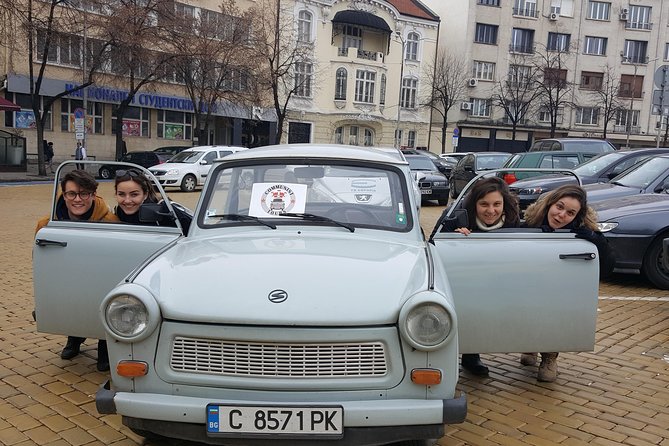
I would choose this tour if you want history with a strong sense of place and a little theater. The Trabant makes the outing especially appealing to people interested in Cold War Europe, vintage cars, political history, photography, and unusual city tours.
It also suits first-time visitors with limited time. You can see several central sites, get a basic framework for Bulgaria’s communist period, and return to your hotel without committing to a full day indoors.
Families with older children may enjoy the novelty of the car, though the historical material about surveillance and political control may be better suited to teenagers and adults. Couples and small groups are likely to get the best value because the price is shared.
I would think twice if you want a long museum visit, a standard walking tour of ancient Sofia, or a detailed architectural study. This is not designed around Roman ruins, Orthodox churches, food, or shopping. Its focus is modern Bulgarian history, socialist art, and the experience of riding in a Trabant.
Booking advice and final verdict
Book this if you want to understand a less familiar side of Sofia while doing something you will remember. The combination of the Trabant, private guide, central landmarks, and Museum of Socialist Art gives the tour a clear identity.
I would book it early, since it is often reserved several weeks ahead and confirmation depends on availability. Pick a time with some breathing room afterward, especially if you enjoy asking questions or want the guide to adapt the route.
The biggest question is value. At $240.28, this is not a budget sightseeing ride. For three people who would otherwise pay for separate transport and a guide, it is reasonable. For one person, it is a splurge. The strongest reason to pay is not simply that you see Sofia, but that you see it through the material culture of the communist era, in the very kind of car that once carried people through it.
FAQ
How long does the Sofia Communist History Trabant Tour last?
The advertised duration is approximately two hours. The actual outing may run longer, with one reported tour lasting over three hours and another lasting just over two.
How many people can join one booking?
A maximum of three people can join each booking.
What is the price of the tour?
The price is $240.28 per group of up to three people.
Is hotel pickup included?
Hotel pickup and drop-off are included for selected hotels. The listed meeting point is ul. Fridtjof Nansen 27 in central Sofia.
What language is the tour offered in?
The tour is offered in English and includes an English-speaking driver-guide.
Which sites are included?
The route includes the National Palace of Culture, the Museum of Socialist Art, the National Assembly area, the National Archives area, the former Communist Party headquarters, and discussions about the political changes leading to 1989.
Is admission to the Museum of Socialist Art included?
Yes. Admission to the Museum of Socialist Art is included.
Can I cancel for a full refund?
Yes, if you cancel at least 24 hours before the experience start time. Cancellations made less than 24 hours in advance are not refunded, and changes within that period are not accepted.
More 2-Hour Experiences in Sofia
- Sofia Highlights 2 Hour Sightseeing Walking Tour
★ 5.0 · 442 reviews - Private 2 Hours Sofia Street Art and Graffiti Tour
★ 5.0 · 3 reviews
New around Sofia
- Private Winter Day Trip to the Rila Mountain★ 4.5 · 3 reviews
- Sofia Hidden Gems: Small-Group Walking Tour with Tram Ride★ 5.0 · 7 reviews
- Veliko Tarnovo and Arbanassi Small-Group Day Trip from Sofia★ 4.5 · 13 reviews
- Via Ferrata Adventure on Kuklata peak 2257 m in Rila Mountain★ 5.0 · 8 reviews
- Tour to Koprivshtitsa and the Buzludzha monument incl the Seuthes Thracian Tomb★ 3.5 · 3 reviews
- Unique experience to sleep in Rila Monastery★ 5.0 · 6 reviews
- Catacomb Tour in Sofia guided by a Local★ 4.5 · 3 reviews
- Full day tour to Plovdiv with lunch★ 4.5 · 12 reviews
Communist Heritage Tours, compared.
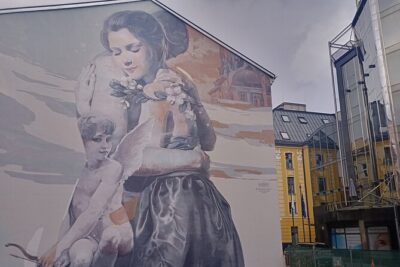
Sofia Food & Tasting Tour with Communist-Era Tram Ride
Read our review →Buzludzha Monument and the Museum of Socialist Art
Read our review →
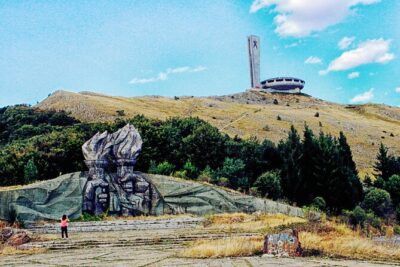
A Day trip to the Thracian Kings, The Valley of Roses & Buzludzha
Read our review →
Explore Bulgaria’s COMMUNISM Era–Todor Zhivkov DayTrip from Sofia
Read our review →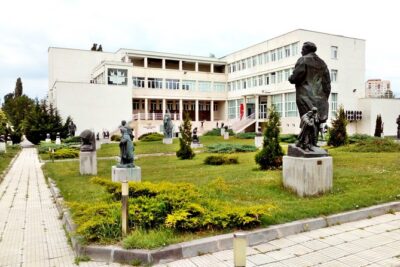
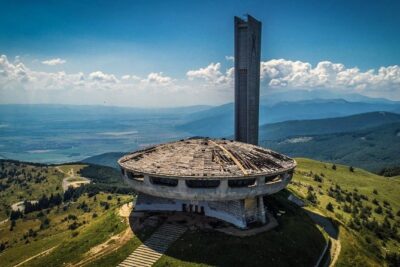
Symbol of the Communism Buzludzha monument and the Rose valley
Read our review →Browse the lists this tour appears in