
Reviewed · CITY TOURS
Sofia: History and Heritage – Small Group City Tour
Sofia’s city center is a history lesson you can walk in a couple of hours. This tour links Alexander Nevsky Cathedral, Saint Sofia Basilica, and Saint George Rotunda with Roman ruins, royal buildings, Communist-era landmarks, and today’s central streets, so you see how several eras occupy the same few blocks.
I like the small-group format, which makes it easier to ask questions, and the practical finish near Vitosha Boulevard. I also like the local advice at the end, including restaurant, museum, bar, and neighborhood suggestions from guides such as Vasil and Vessy.
The main consideration is pace. You will cover a lot on foot, with little time to sit apart from a short café break. If you want a slow architectural study or extended church visits, this compact introduction may feel brisk.
Key points to know before booking
- Three major churches: Visit Alexander Nevsky Cathedral and Saint Sofia Basilica, and see Saint George Rotunda as part of the central walking route.
- A remarkably compact route: Sofia’s main central sights are close together, letting you cover Roman remains, royal sites, government buildings, and grand public squares without transport.
- Small groups, even with one participant: The tour is designed for up to 10 people, with a stated maximum of 15, and it can operate with only one booking.
- Local guidance beyond the landmarks: Your guide provides ideas for traditional restaurants, museums, bars, Bulgarian dishes, and areas to explore afterward.
- Good value at $19.31: For roughly two to two and a half hours with a guide, the price is low, especially for a first morning in Sofia.
- Easy finish for independent sightseeing: The walk ends at the start of Vitosha Boulevard, Sofia’s main pedestrian shopping street.
Why this short Sofia walk works
Sofia can be confusing at first because its story is spread across a small but visually mixed center. A Roman ruin may sit beside a modern government building. A church may occupy ground used for worship for many centuries. A grand square may recall monarchy, war, religious authority, and Communist-era politics within one view.
That makes a guided walk useful. You are not simply checking off monuments. You are learning how the city fits together. The route gives you a framework for later sightseeing, so a building you pass again will have a name and a reason to matter.
The guides are a major part of the experience. Vasil is described as leading many of the tours, and Vessy also guides the walk. The strongest qualities associated with both are clear English, strong command of Sofia’s past and present, punctual organization, and a willingness to answer questions.
I especially like that the tour is not limited to the postcard sights. Along with the major churches, you pass the old Parliament, the Synod, the National Library, the Monument to the Liberator King, the former Royal residence, the National Theater, the Largo complex, the Presidency, Roman remains, the old Baths, and the Judicial Palace.
That list sounds formal, but its value is practical. You get a map of central Sofia’s public life, not just a visit to one cathedral. You also see places you might otherwise walk past without understanding what they are.
More history tours in Sofia:
- Full-day Nis and Serbian History Tour from Sofia
★ 4.5 · 90 reviews - Sofia Communist History 2-Hour Tour in a Classic Trabant
★ 5.0 · 45 reviews - Rila Monastery and St. Ivan Cave History & Nature Trip from Sofia
★ 4.5 · 25 reviews
Alexander Nevsky Cathedral begins the story
The meeting point is at Sofia’s old city center, on Saint Alexander Nevsky Square. This puts you beside the city’s best-known church from the start.
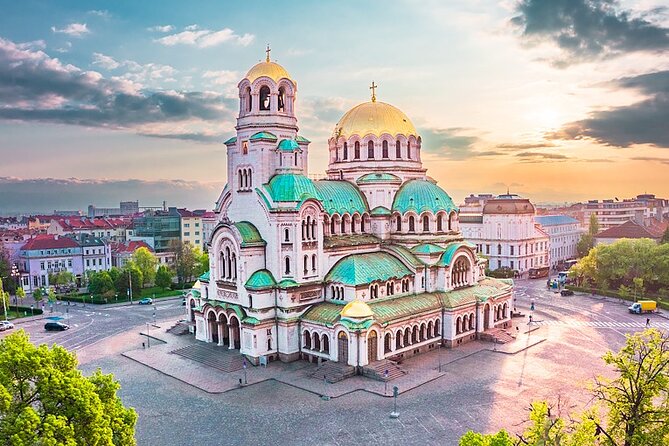
Alexander Nevsky Cathedral is a powerful introduction to Sofia. Its scale and formal design immediately tell you that the building is more than a local parish church. It is a national symbol, and the tour includes a visit inside.
Your guide can give the church a place in Bulgaria’s wider story, rather than leaving you to admire the exterior and move on. Pay attention to the details your guide points out, since the value of the stop comes from understanding what the building represents as much as from taking photographs.
The cathedral also gives the group a clear reference point. From here, the walk moves into a central area where religious buildings, civic monuments, and archaeological remains sit close together.
This is one place where the short duration can work in your favor. You receive an informed introduction without spending half a day on a single building. If cathedral interiors are your main interest, you may want to return later for a longer, quieter visit.
Saint Sofia Basilica and the older layers beneath the city
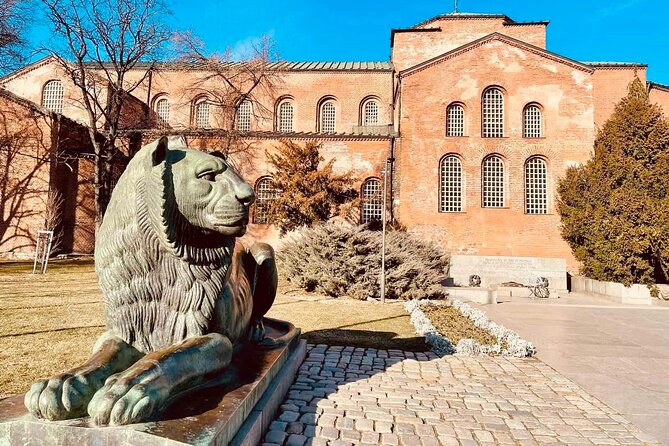
The next major church is Saint Sofia Basilica, a building that gives Sofia its name. The tour includes entry here, so you can see more than the exterior.
Saint Sofia is important because it connects the present city with its early Christian past. Its plain, solid appearance differs from the grander Alexander Nevsky Cathedral. Seeing both churches in one walk helps you notice how religious architecture can express different periods and purposes.
The basilica is also a good setting for the guide’s less familiar stories. The tour promises lesser-known facts, and this is the kind of stop where context matters. Without explanation, an old church can look like one more monument. With a guide, you can better understand why it has survived and why it remains central to Sofia’s identity.
The route also includes Saint George Rotunda, one of the city’s most striking ancient structures. It is set within the modern center, surrounded by later buildings and public spaces. That contrast is one of Sofia’s great pleasures: you can move from a contemporary street into a site that belongs to a much earlier city.
The stop is especially useful for understanding how Sofia was built in layers. Roman, Christian, Ottoman, royal, Communist, and modern Bulgarian periods are not separated into different districts. They overlap.
Roman remains, the old Baths, and Sofia’s layered center
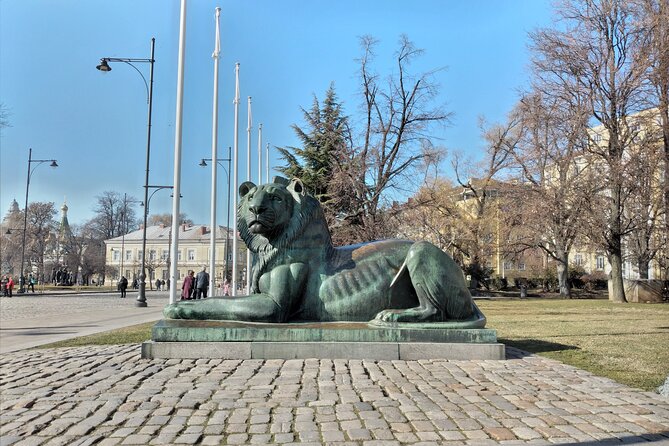
The Roman remains are among the most interesting parts of the route for anyone who wants more than a standard city-center walk. The tour also passes the old Baths, adding another piece to Sofia’s ancient urban story.
You might otherwise see these remains as fragments in the middle of town. The guide’s role is to explain how they relate to the larger settlement and why they are still visible among modern streets.
This is where the tour’s combination of famous sights and less obvious places pays off. You see the buildings that appear in guidebooks, then connect them to archaeological traces that can be easy to miss.
The route does not require a long transfer between districts. Most major stops are close together, so the walking is manageable for many people. Still, do not interpret compact as effortless. One person found the two-hour route tiring because there was little chance to sit. You should expect to remain on your feet for much of the experience.
Comfortable shoes are a sensible choice. The tour is not presented as a strenuous hike, and one participant described it as easy walking, but the group moves between many sites and stops. The café pause offers a chance to refresh, not a full meal or a long rest.
A few more Sofia half-days worth a look
- Rila Monastery and Boyana Church Full-Day Tour
★ 4.5 · 918 reviews - Sofia Escape Room – Teorema Rooms
★ 5.0 · 895 reviews - From Sofia: Rila Monastery & Boyana Church Day Tour
★ 4.5 · 866 reviews - Communist Walking Tour of Sofia
★ 5.0 · 690 reviews
Royal, civic, and modern Sofia along the route
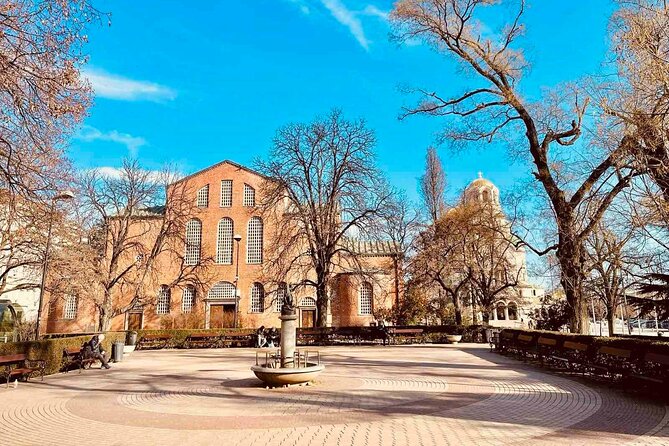
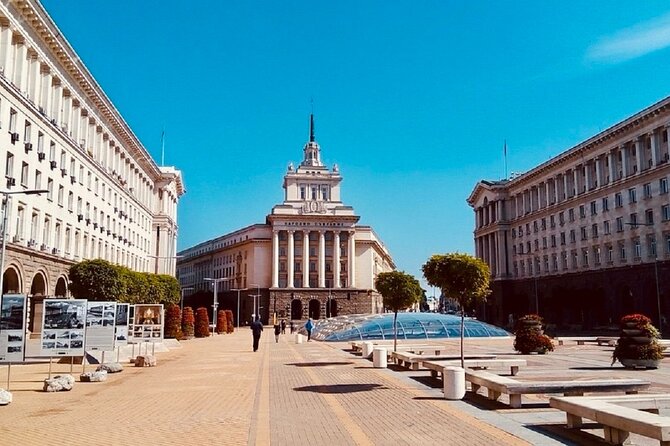
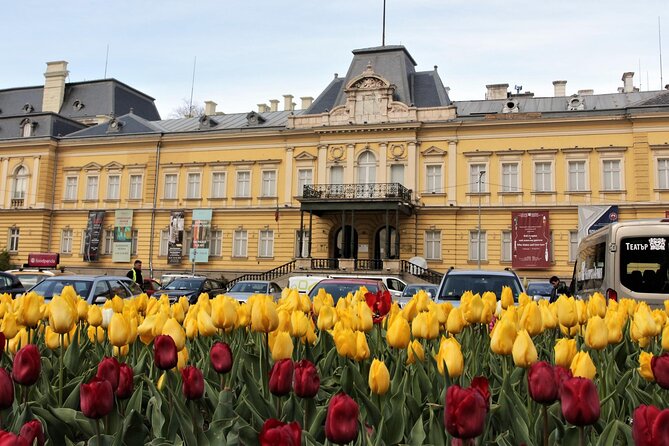
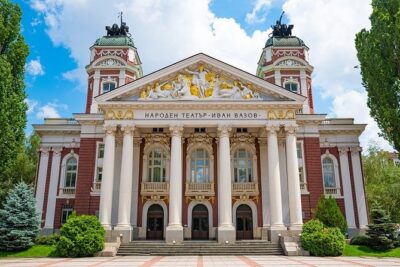
The walk gives substantial attention to Sofia’s civic center. You pass the old Parliament, the Synod, the National Library, the Monument to the Liberator King, the former Royal residence, and the National Theater.
These places help explain how Bulgaria presented itself as a modern European state. They also give you a better sense of the city beyond churches and Roman remains. Public buildings show another side of Sofia: government, education, performance, monarchy, and national memory.
The old Royal residence is particularly useful for seeing how power was once displayed in the city. The former Parliament and the Synod add different institutions to the same central picture. The National Theater brings a cultural dimension, while the National Library points to education and public life.
A good guide will help you distinguish these buildings rather than treating them as a parade of grand façades. Vasil is repeatedly described as organized and clear in English, with a strong ability to explain history and culture. Vessy is also described as passionate about Sofia and Bulgaria.
The route also takes in the Largo complex and the Presidency. These sites bring the story closer to modern statehood and recent public life. They are useful stops for anyone trying to understand how Sofia functions today, not only how it looked centuries ago.
The Largo and the city’s changing identity
The Largo is one of the central spaces you will see on the tour. It is an important stop because it places several major public buildings and historical layers in one area.
Here, the guide can connect architecture with political change. Sofia’s center is not a single-period museum. Different governments and eras have left their marks, and the Largo helps you see those changes in one setting.
The Presidency is another useful landmark because it represents present-day state power. Set beside older religious and archaeological sites, it makes the city’s timeline visible. This is one of the tour’s strongest themes: Sofia’s past is not fenced off from daily life.
You also pass the Judicial Palace and other central buildings. These stops may appeal most to people who enjoy institutions, architecture, and political history. If your ideal tour focuses only on food or local shops, this experience may feel formal at times.
Still, the guide’s storytelling seems to keep the route from becoming a dry list of names. The emphasis is on stories, context, and facts that you may not pick up while walking alone.
A café pause and useful advice for the rest of your stay
A short café break comes in the middle of the walk. This is a small feature, but it matters on a walking tour with many stops. You get a moment to refresh and ask questions in a less hurried setting.
Do not expect a long meal or a major food experience. The break is best understood as a pause that keeps the group comfortable.
The advice after the tour is more substantial. You receive suggestions for traditional restaurants and museums, and the guide may also recommend bars, neighborhoods, and typical Bulgarian dishes. That can save you time later, especially on a first visit when you are unsure which central streets are aimed at tourists and which places fit your interests.
One particularly useful feature is the tour’s finish. It ends at the beginning of Vitosha Boulevard, the main walking street. You can continue independently from there, stop for food, explore nearby shops, or use the guide’s suggestions while the city layout is still fresh in your mind.
This makes the tour a good first activity rather than an isolated excursion. You finish in a part of town where it is easy to continue your day.
Group size, timing, and the pace of the walk
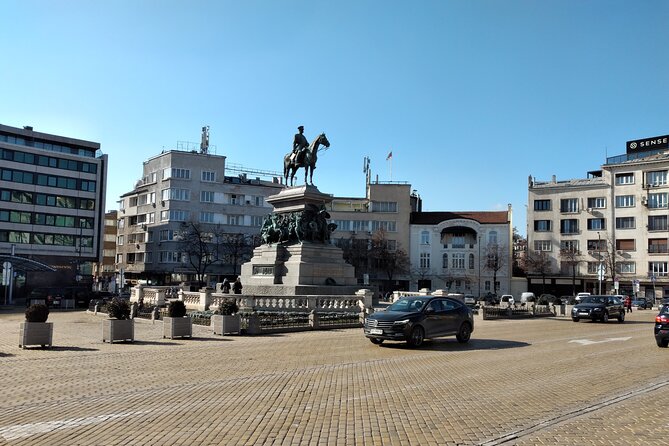
The experience lasts about two to two and a half hours. The included description also refers to a two-hour guided tour, so allow a little flexibility rather than planning a strict appointment immediately afterward.
The small-group design is one of the best practical features. The tour is described as operating with up to 10 participants, while the additional information gives a maximum of 15. In either case, it is intended to be much smaller than a large coach tour.
The tour can run even with one participant. That is unusual at this price and useful if you are visiting during a quiet period. A very small group also makes it easier to ask about Bulgarian history, food, museums, or places you notice along the way.
There is a tradeoff. If you prefer a lively group atmosphere, a one-person or three-person departure may feel more like a private lesson than a social outing. For most people, though, the flexibility and chance to ask questions are worthwhile.
The route is close to public transportation, and most people can take part. It is still a walking activity with limited seating. Anyone who needs frequent rest should keep that in mind before booking.
Is $19.31 a good price for Sofia?
At $19.31 per person, this is an inexpensive way to orient yourself in Sofia. The price includes a guided walk of the central sights, visits to Alexander Nevsky Cathedral and Saint Sofia Basilica, and a small-group format.
You are not paying for a long-distance transfer, a meal, or special admission package. The value comes from the guide’s explanation and the efficient route. If you tried to identify every landmark on your own, you could see the buildings, but you would miss much of the connection between them.
The tour also saves you the cost of a private guide. Even if you end up booking a museum or restaurant separately, the initial orientation can help you choose where to spend the rest of your money and time.
Tips are optional and not included. You can decide at the end based on the guide’s preparation, clarity, and personal attention.
The price is especially appealing for a first day in Sofia, a short city break, or a solo visit. If you already know the center well, the value depends more on your interest in historical stories and local recommendations.
Who should book this Sofia tour?
I would recommend it most strongly to first-time visitors, history fans, solo visitors, couples, and anyone who wants a clear introduction before exploring alone.
It suits you if you want to see the major center in a short period, ask questions in English, and learn where to eat or what to visit afterward. It is also a good choice for people who often walk past monuments without knowing their purpose. The guide helps turn ordinary-looking corners into meaningful stops.
Families can also find the small group helpful, particularly because the route can operate even with a stroller and the guide may adjust to the group. Still, the two-hour walking format requires enough stamina to remain on your feet.
You may want another type of tour if your priority is a long cathedral visit, a food tasting, a museum interior, or a relaxed café-centered afternoon. This is a broad orientation walk, not a specialist architecture course or a full-day cultural program.
The tour is offered in English. Confirmation is provided at booking, and free cancellation is available up to 24 hours before the start time. Changes or cancellations inside that window are not accepted for a refund.
Should you book it?
Book this tour if you want a low-cost, well-organized introduction to Sofia’s center with churches, Roman remains, royal buildings, government landmarks, and useful local advice in one walk.
I would choose it early in a Sofia visit, ideally before deciding which museums, restaurants, and neighborhoods deserve more of your time. Vasil and Vessy appear to bring the right mix of historical explanation and practical city advice, and the small group gives you room to ask questions.
Skip it only if you dislike walking, need long seated breaks, or already have a strong understanding of central Sofia. For most first-time visitors, the price, route, and finish near Vitosha Boulevard make it a sensible start.
FAQ
How long does the Sofia city tour last?
The tour lasts approximately two to two and a half hours. The included description also refers to a two-hour guided tour, so allow some flexibility with your schedule.
What is the price of the tour?
The listed price is $19.31 per person.
Which churches are included?
You visit Alexander Nevsky Cathedral and Saint Sofia Basilica. The route also includes Saint George Rotunda.
What other Sofia landmarks will I see?
The walk includes the old Parliament, the Synod, the National Library, the Monument to the Liberator King, the old Royal residence, the National Theater, the Largo complex, the Presidency, Roman remains, the old Baths, the Judicial Palace, and other central sights.
Is the tour offered in English?
Yes. The tour is offered in English.
How large is the group?
The tour is described as a small-group experience with up to 10 participants. The additional information gives a maximum of 15 travelers.
Can the tour operate with only one participant?
Yes. The tour operates even when there is only one participant.
Where does the tour end?
It ends in Sofia’s old city center at the beginning of Vitosha Boulevard, the main walking street.
Is a café stop included?
Yes. The tour includes a short break at a café so you can refresh during the walk.
New around Sofia
- Private Winter Day Trip to the Rila Mountain★ 4.5 · 3 reviews
- Sofia Hidden Gems: Small-Group Walking Tour with Tram Ride★ 5.0 · 7 reviews
- Veliko Tarnovo and Arbanassi Small-Group Day Trip from Sofia★ 4.5 · 13 reviews
- Via Ferrata Adventure on Kuklata peak 2257 m in Rila Mountain★ 5.0 · 8 reviews
- Tour to Koprivshtitsa and the Buzludzha monument incl the Seuthes Thracian Tomb★ 3.5 · 3 reviews
- Unique experience to sleep in Rila Monastery★ 5.0 · 6 reviews
- Full day tour to Plovdiv with lunch★ 4.5 · 12 reviews
- Catacomb Tour in Sofia guided by a Local★ 4.5 · 3 reviews
City Tours, compared.

Private Sofia Guided Walking City Tour with Traditional Breakfast
Read our review →
The Oldest European City – Plovdiv with Audio guide
Read our review →Browse the lists this tour appears in